NotebookLearning
Specs are the design now. My notes before and after the course.
I took NN/g's course on writing specs for AI-built products. Here's what I thought going in, and what stuck after.
I'm about to take NN/g's course, Writing Specs for AI-Built Products. Before I start, I want to get down what I think now. That way I can be honest later about what changed.
Why I care
At my last job I was already doing a version of this. I wrote a design MD, component MDs and design intent docs, and AI tools built from them. On FloGrid and LVL Health, a lot of the front end was written by agents reading those files.
So when NN/g put out a podcast called Specs Are the New Source Code, it felt like someone finally put a name on what I'd been doing.
What I think going in
If you don't write it down, AI fills it in with the average. Leave something vague and you get the default. That's how you end up with a product that looks like everything else.
A mockup doesn't say enough anymore. It shows the layout. It doesn't show what happens when a list is empty, or why red only ever means an error. That used to live in my head and in handoff meetings. Now it has to be written down.
Designers should own the "what it should be" part. Engineers own the technical stuff. The part about how the product should work and feel is ours.
Write the rules first. On FloGrid I wrote most rules down after making the same mistake twice. When agents build from the spec, that's too late.
What I'm reading
- NN/g, UX-Context Design. UX work is turning into context we hand to AI, not just docs for people. And that context is never done. You update it every time the AI gets something wrong.
- Anthropic, The AI-native SDLC playbook. Every step writes a file the next step reads: intent, spec, plan. People approve at checkpoints.
- AWS, AI-Driven Development Life Cycle. Same idea, very engineering-focused. Google Cloud has its own take too.
- Jeff Gothelf, The Impact of AI on UX Design Work. The reality check. Faster isn't better, and leaning on AI too much makes everything look the same.
What I'm noticing
Everyone agrees on one thing: writing code got cheap, and deciding what to build didn't.
Where they differ is where design fits. The engineering playbooks treat the spec like a gate: nothing gets built without an approved plan. NN/g seems to go further. Check the build against what you meant, not just what you wrote, then decide what to fix.
That's what I'm most curious about. What does "what you meant" look like on paper?
Questions I'm bringing
- Taste keeps moving away from whatever's average. How do you write taste into a spec without it becoming the next average?
- How much of a spec can be a template I reuse, and how much has to be custom?
- Where does my spec end and the engineer's begin?
- The Figma file, the spec and the code all want to be the source of truth. How do you keep just one?
I said I'd write a follow-up once I was through the course, so here it is. If my answers changed, good. That's the point.
Writing specs for AI-built products
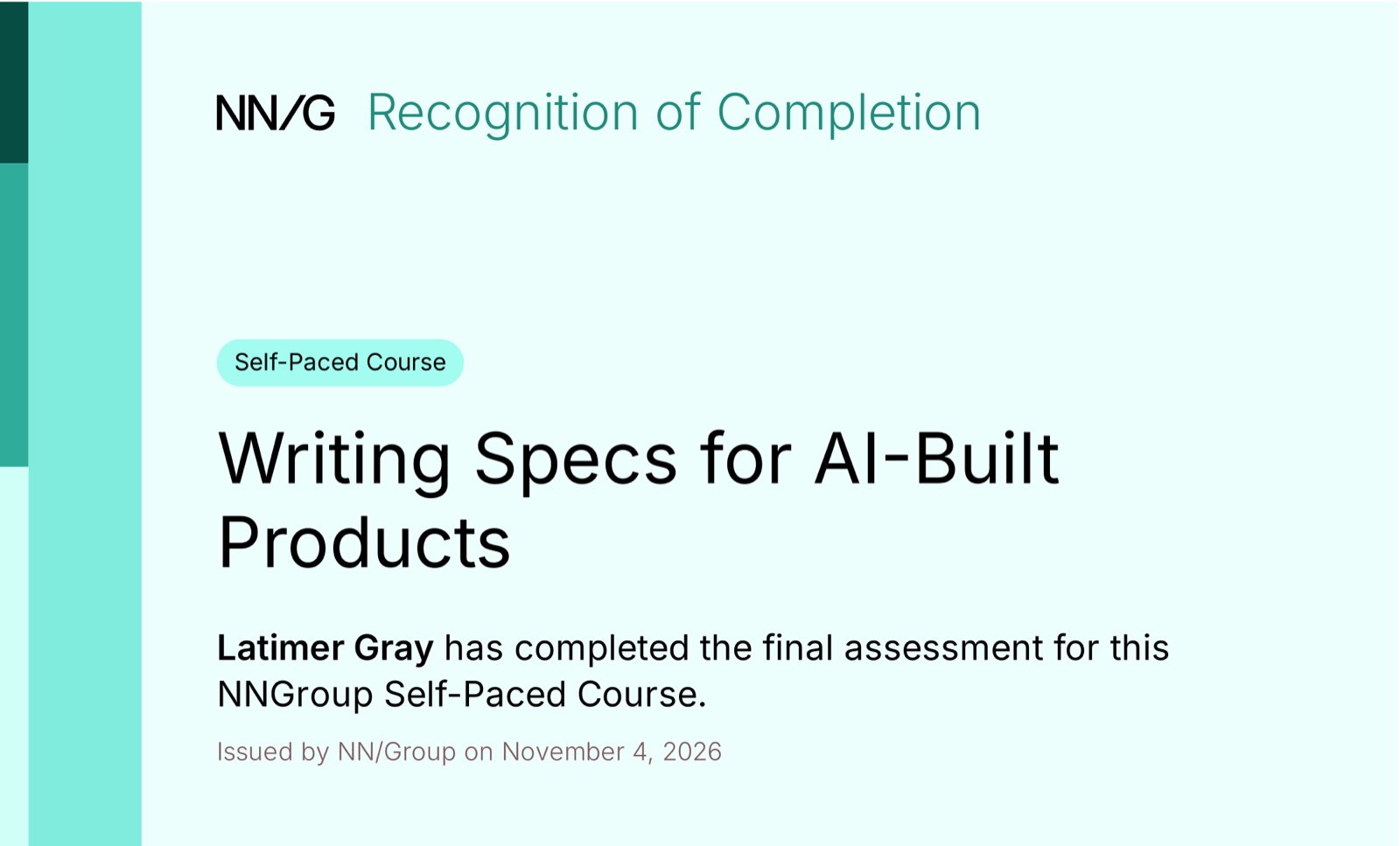
This month I took Nielsen Norman Group's self-paced course Writing Specs for AI-Built Products, taught by Thomas Watkins. I'd been listening to his podcast for a while, so I already knew he had a lot to say about this. The course didn't disappoint.
The short version: AI can build features faster than most teams can design them. Anything a designer doesn't write down gets filled in right away by a developer's best guess, a template, or whatever the AI assumes. The course calls that "automated intent" instead of design intent. A spec is how you get your thinking into the build before the defaults do.
What stuck with me
- Specs don't replace Figma. They explain it. Screens show what something looks like. A spec says how it behaves: what triggers it, what each person sees, and when it ends.
- One status can mean different things to different people. In the course example, a field service app, "In progress" is a yes/no metric for the dispatcher. For the technician pulling up to a locked gate, it means "what do I do now?" A good spec covers what each role needs in that moment, not just the action.
- Start with a brain dump. Before writing anything, get it all out: context, what you know, what you don't, your gut instinct. The open questions become the TBDs in the spec instead of surprises in production.
- Not everything belongs in the spec. Ask whether a decision will affect someone who wasn't in the room: a future developer, an AI, or me in six months. Behavior goes in the spec. Corner radius goes in the design system.
- Keep one living document. Update what changed, point to what didn't, and don't regenerate the whole thing every time. A good spec gets more certain over time, not just longer.
- Judge the build against users first, the spec second. Specs are imperfect. Every problem you find in a build traces back to one of three gaps: the idea could have been imagined better, written better, or built better.
Why it hit home
The course example felt familiar. Over the past year I worked on a resource management and workforce allocation platform, where managers moved people across projects and the people being moved had their own context and needs. That's the same tension as the dispatcher and the technician. One change, a different meaning for each role.
A lot of what I'd been doing on that project already lined up with the course: discovery walkthroughs, weekly prototype reviews with stakeholders, testing during UAT, and writing design and component MDs so an AI-assisted build had something to follow. The course didn't change that approach. It gave it a clearer structure and some better words for it, and it made me a lot more deliberate about design intent.
Will it last?
Honestly, I don't know how long any AI workflow stays current. The tools change every few months. But writing down what you meant, and why, before someone else decides it for you is not a new idea. It just matters more when things get built this fast. I'm betting that part holds up.
I've already turned my notes into a spec template and a working checklist that I'll use on the next notebook project.
I also built a skill based on the course, so Claude works the same way I do: brain dump first, then the spec, then keep it updated and check the build against it.
View my certificate of completion (PDF)